Feb 20, 2019

Parents held without bail after baby ingests fentanyl

The parents of a 1-year-old girl are being held without bail pending a dangerousness hearing after the baby was rushed to the hospital for fentanyl exposure.

The baby is expected to live and recover fully. Fentanyl is a man-made opioid responsible for numerous overdose deaths across the region and the nation.

It is the second time in recent months that a local child has been hospitalized for exposure to fentanyl. Precious Wallaces, 11, of Haverhill, died a few days after exposure to fentanyl on Dec. 15.

"The magnitude of the opioid crisis rises to a whole new level anytime children are involved," Lawrence Police Chief Roy Vasque said in a statement. "It becomes even more alarming when it involves an infant as in this case. This is not a local or even a Commonwealth of Massachusetts issue, but rather the largest epidemic of its kind the country is facing. As a result there needs to be a comprehensive nationwide plan in the area of enforcement, education, and rehabilitation."

The baby girl was taken to Lawrence General Hospital on Monday after her mother found her with a pill in her mouth. Her mother took her to the hospital, where she was admitted after testing detected the presence of fentanyl.

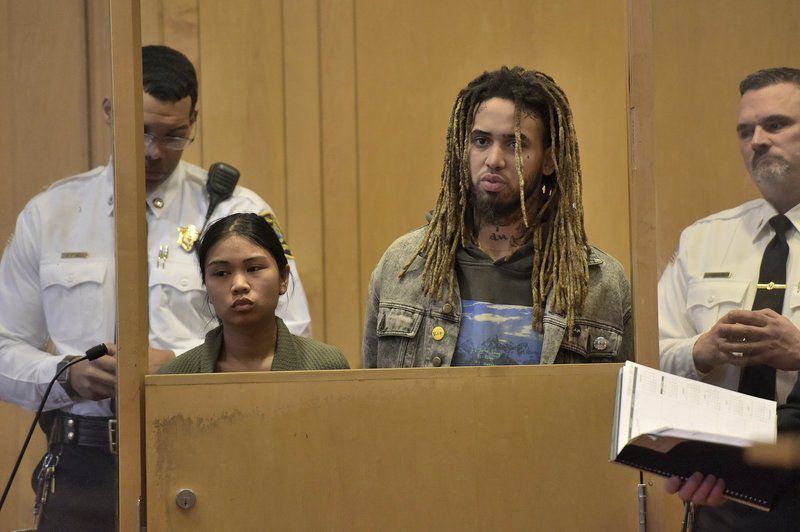
At their arraignment Tuesday morning, parents McDanner Pereyra and Jennifer Ouch, both 27 and from Lawrence, were ordered held until a dangerousness hearing Feb. 26. If that hearing determines they are a danger to society, they will continue to be held without bail.

Police said Ouch lied to them by saying the girl found a pill on the floor of a store and put it in her mouth.

The girl's 6-year-old brother told officers she actually picked up the pill at their home and put it in her mouth, according to a police report on file at Lawrence District Court.

Pereyra later admitted that he told Ouch, who is his girlfriend, to lie and say the pill came from the store, according to the police report. Pereyra said he told her to lie because he feared the state might take their children away, according to the report.

When Ouch noticed the pill in her mouth, she removed it and washed the child's mouth out with water, according to a statement made by the girl's brother to police. Pereyra told Ouch to take the girl to the hospital, where medical personnel determined she had fentanyl in her system, but that she would make a full recovery, the report said.

When executing the search warrant, police discovered a variety of illegal narcotics and ammunition, for which a license to carry a firearm or FID card is required, Cuddy said.

According to the police report on file at Lawrence District Court, police searching the home found a plastic bag containing what appeared to be 32.1 grams of fentanyl. The bag was on top of the kitchen cabinets, the report said. Police found another bag of what appeared to be 11.8 grams of fentanyl in a bag in the kitchen pantry, the report said.

The report said officers also found other items in the home: In the parent's bedroom closet was a zip lock bag containing 17 promethazine hydrochloride tablets. Promethazine is an anti-allergy medication that can cause drowsiness. Also in the closet were two Xanax bars and half a Xanax bar. Xanax is an anti-anxiety medication. A bar is a tablet that has been scored by the manufacturer to be broken easily into smaller doses.

Police said the Pereyra denied ownership of all the ammunition and the gun box, saying it belongs to a friend. He also denied owning a gun, according to the police report. The report indicated he said the bag of powder in the pantry wasn't his and that he doesn't believe it is drugs, and also that he denied dealing any drugs other than marijuana.

Precious died several days later at Tufts Medical Center in Boston, where she had been in a coma and on life support.

Autopsy testing of the girl's body revealed the presence of fentanyl and amitriptyline, a sleeping medication.

The girl's uncle, Miguel Rivera, 58, of 233 Jackson St., #5, was charged in January with permitting bodily injury to a child and misleading a police investigation in connection with Precious' death. Rivera was also charged with rape of a child.

Jan 3, 2019

Family welcomes first baby of 2019

Lindsey and Ben Thigpen smiled proudly as their new bundle of joy slept peacefully in her mother's arms Tuesday afternoon.

Hadley Jean, the first baby born at Altru hospital in 2019, weighs 6 pounds 9 ounces and is 21 inches long. She was delivered by Dr. Collette Lessard at 1 a.m. Tuesday, Jan. 1, just missing 2018 by an hour.


Lindsey said she and her husband joked about the baby coming on New Year's Eve, but once that hour passed she didn't even think about Hadley being the first baby of 2019.

"We had joked about her being born in 2018 and getting the tax break, we missed that by an hour," Ben said with a laugh.

Hadley Jean was originally set to arrive about a week later, on Jan. 8, Lindsey said.

The couple also has a one and-half-year-old son named Westley, who was proudly sporting a "big brother" T-shirt and smiling as he pointed at his baby sister saying "baby" nearly every time he looked at her.

"We're just very happy that she's finally here and that we finally get to hold her," Lindsey said.


Nov 9, 2018

We can't let poorer pupils be frightened off higher education

Back in the days when higher education was mostly for the benefit of a select group of middle-class kids, I had a meeting with my school careers teacher, who asked me what I wanted to do in the future. When I told her I was thinking about furthering my studies and finding a job that involved writing, she declared that a suitable plan for me was to leave school at 16 and train to become a secretary. Apparently I didn't look like the sort of person who should attend university.

Over time I'd come to believe these attitudes belonged to the past – a bygone age of middle-class privilege now thankfully over. Now, though, it seems that thinking has become core government policy.

It seems to be more difficult than ever for young people to enter higher education. Graduates in England have the highest student debts in the developed world. They will leave institutions with nearly double the debt of their US counterparts, and three times the debt of the next highest in Europe. A commons committee this week found a wide gap in access between the most and least advantaged students, despite institutions' spending on access and widening participation schemes. It saw evidence that showed that poorer students were hit hardest by the system of student loans, and expressed concern at the drop in numbers of part-time and mature students. Thanks to the abolition of maintenance grants in 2015, the poorest students will pay on average £14,000 more in loans than better-off students. Once they emerge from their studies, on average they will have forked out a grand total of £57,000, according to the Institute of Fiscal Studies.

And universities themselves are facing unprecedented criticism. Since the summer, accusations have raged about a rise in the number of unconditional offers given out. The institutions have been blamed for a "bums on seats" mentality by the higher education minister Sam Gyimah, who appears to have forgotten that just four years ago the government lifted the cap on student numbers in an effort to marketise higher education. Then there have been exaggerated and often false claims about no-platforming and safe spaces.

Oct 22, 2018

Daycare costs set to soar next year as new rules for baby care come into effect

The cost of regulated childcare in day care centres or creches is set to rise by some 7% because of new government rules, childcare groups say in Tuesday’s AD.
 Sector umbrella group Kinderopvang says parents will have to pay hundreds of euros more a year because of changes to rules governing the care of babies. From January 1, a baby group worker will only be allowed to look after three babies, rather than four as at present. This means creches will have to employ more staff or turn children away. Small creches are particularly hard hit by the need to take on more staff, Kinderopvang says. It estimates a low-income family with two children who go to daycare three days a week will be €800 worse off a year because of the changes. The extra cost to the same family with an average income will be €900. Child benefits are going enough but not enough to compensate for the rise, Kinderopvang says.

Child benefits A spokesman for the social affairs minister said the government does not expect such a large increase. It estimates the rule change will boost costs 4.6% and says that will be covered by the rise in child benefits. Daycare group De Kleine Wereld expects premiums to rise by 10%. ‘The ministry thinks we will cover the cost by attracting more toddlers and offering after-school care,’ director Erik Vlutters told the AD. ‘But that is not how things work. Most children start here as babies and grow into toddlers. You don’t suddenly take in toddlers. And most creches do not have facilities for after-school care,’ he said.

Sep 27, 2018

Go for natural, paraben free baby care products

As parents, we all are highly concerned about what goes into our baby's body, but are we that concerned about what goes "on" our baby's body? The baby products market is one of the fastest growing industries in India and baby skincare products constitute a huge market. In the era of flourishing marketing, companies producing baby care products leave no stone unturned for forming an emotional connect with parents while talking about their products.
Usually, the emotional aspect of products takes over the major part of marketing, while what goes within is kept under wraps. The main reason behind this is the number of chemicals that go within these products to give them an appealing shape. The wipes that we use on our child's skin or those lovely smelling lotions come wrapped in a lot of chemical and alcoholic content. Multiple ingredients used to control wetness, prevent bacteria and make bottoms smell more pleasant actually come with the likelihood of leaving an impact on the health of our little ones.
Researchers have found that with the lotions, shampoos, talcs and a few other personal care products, our babies are more susceptible of being exposed to one of the most harmful toxics called parabens. For those parents who are not aware of parabens, these are a type of preservatives introduced in 1950s to prolong the life of health and beauty products by preventing the growth of mould and bacteria within them.
The paraben family of preservatives have been identified to penetrate the skin and remain within the tissue and often lead to allergic reactions, rashes, an increased risk of cancer and hormonal problems, including infertility. The Environmental Working Group (EWG) claims: "Parabens mimic oestrogen and can act as potential hormone (endocrine) system disruptors."
Likewise, Benzyl alcohol often used in baby care products is a neaurotoxicant which is allergic to lungs and skin, leading to itching, burning, blistering and much more. The list of chemicals that are used in baby care products is again, endless. Ethylhexylglycerin, a chemical that is widely used as a deodorant agent and to condition the skin, has been found as a skin irritant, causing dermatitis and eye irritation.

Aug 13, 2018

Sign Language Isn’t Just for Babies


Baby sign language borrows some signs — like "milk," "more," "all done," "mommy" and "daddy" — from American Sign Language in order to enable hearing parents to achieve some basic sign- and gesture-based communication with their infants before they are capable of speech. In my view, the more people who sign in this world, the better. And I defy you to suppress a smile when a baby signs "more" by bouncing her chubby little fingertips together.

But part of me also objects when baby signs are marketed in a vacuum, isolated from their origins in the full, rich American Sign Language that I know. The increasingly mainstream trend — driven by parenting books and how-to videos — is largely being pushed by hearing people, for the benefit of hearing children. It seems like a major missed opportunity to take advantage of the contributions that deaf people — the primary users (and originators) of signed languages — can offer to the world.

Leading proponents of baby signing say that it's a way for parents to develop stronger bonds with their babies, and that it has benefits for language development and cognition, though the evidence for this among hearing children is weak. Signing is also clearly valuable for children whose brains might be better suited to visual rather than verbal communication: not only deaf children, but also those with autism and other forms of cognitive difference.


The baby sign language phenomenon connects to what culturally deaf people celebrate as "Deaf Gain:" the notion that all of humanity can gain significant benefits and insights from Deaf visual-spatial contributions to the world, including A.S.L. and all its rich linguistic possibilities. Deaf friends I talk with applaud hearing parents for learning some signs with their children, and express hope that, someday, more people will use a signed language on an everyday basis, making communication easier for all of us.

But the developers and users of baby sign language don't necessarily see A.S.L. fluency as a goal. Many of the books and websites actually assure parents that they don't need to learn full A.S.L., and also that using baby signs won't impede a child's spoken language acquisition.

Most striking for me, when I browsed top-hitting baby sign videos on YouTube, I found several that featured stretches of verbal speaking and singalong, without any captions. I was watching visual fragments of my own language, framed by spoken English, which excludes me. I felt disjointed, oddly erased.

Finally, there is one more reason I feel ambivalent when my hearing acquaintances tell me they are using baby signs with their children. Often, I notice that these acquaintances are people who have never attempted to use any sign language with me — even though I am deaf, even though I am the one person they know who could most benefit from visual communication. This omission strikes me as a huge loss, even a huge injustice.

Jul 18, 2018

Horrific catalogue of early education care complaints detailed in Ministry report

 Cases of rough handling, inadequate supervision and children going unfed have surfaced in a horrific catalogue of complaints against early childhood education services.

The Ministry of Education released a report this morning featuring all the complaints about early childhood education (ECE) received in 2017.

They received 339 complaints about early learning services and investigated 297 of them - the further 42 did not require an investigation.

Of those investigated, 166 were upheld, which means that standards were either not met or the investigation found there were areas which needed improvement.

 Here are some of the cases that were investigated:

• Service informed the Ministry after a teacher roughly handled a child, resulting in a dislocated shoulder.

• NZ Police notified Ministry of an infant who was shaken while at service. Educator was charged and sentenced.

• Children were force-fed and concerns about the teaching practice by the head teacher were raised. Two staff members suspended and subsequently resigned.

• A staff member was stood down after arriving at the service under the influence of alcohol.

• A teacher was dismissed after pulling the chair out from under a child.

The Ministry suspended the licences of six services, cancelled nine services and changed 31 services' licences to provisional after a number of complaints.

A spokeswoman for the Ministry said it would not be releasing the names of the centres.

Eight more complaints were received last year than in 2016, but the number of upheld complaints remained largely the same, the Ministry said.

"Every complaint we receive is treated seriously," Deputy Secretary Sector Enablement and Support Katrina Casey said.

"We assess each complaint, and if a service falls short of the standards we impose conditions for improvement or shut the service down."

Complaints stemmed from children suffering broken bones, service work conditions, how they are managed by staff, and the use of inappropriate language.

Other cases of interest featured a service temporarily being placed on a provisional licence after a child died shortly after being picked up from care.

A service also reported a "near-miss" after a child climbed into a storage container and was accidentally locked inside it for a short time.

The child was soon discovered and was distressed but had no physical injuries and recovered quickly after some care from staff.

Another service's licence was cancelled after a complaint alleged a staff member hurt a child through rough handling.

The same complaint alleged that children had left the premises unattended, children went unfed and there was inadequate supervision.

Te Rito Maioha Early Childhood New Zealand praised the Ministry for listing and taking every complaint seriously.

"It goes without saying that any practice having a negative impact on tamariki is totally unacceptable," Kathy Wolfe, the chief executive of the early childhood lobby group and teacher training provider, said.

However, she said the report also showed parents can have confidence the majority of Kiwi youngsters were in good hands, given 97 per cent of licensed ECE services meet or exceed Ministry of Education standards.

NZ Educational Institute Te Riu Roa president Lynda Stuart also welcomed the report, saying any case of substandard care of our youngest children was distressing.

"We're continuing to lobby for increased funding for centres with 100 per cent qualified teaching staff, better teacher-to-child ratios, smaller group sizes and increased operational funding, which all contribute to the quality of ECE services."

Early Childhood Council chief executive Peter Reynolds said there should be no tolerance for services that put children at risk so it was good to see the Ministry of Education being responsive to complaints.

"It is important parents, whanau and caregivers can have confidence in the systems and the ECE services they choose," he said.

By law, ECE services are required to have processes in place so that parents can complain or ask questions if they're not happy with their child's education and care.

"Most complaints can be managed at the service level but parents, whānau and caregivers are encouraged to come to us if they are not satisfied with the response from a service or if the complaint is potentially serious.

"We continue to look at ways to improve our management of complaints and to use the insights from our investigations to improve our services.

"Nothing is more important than the safety and wellbeing of our children," Casey said.